You were told diabetes is a lifelong condition. Take your metformin. Control your diet. Come back in three months. Three months turned into three years. Three medications. Rising doses. Your HbA1c hasn’t moved in a year and nobody’s changed the approach.
You’ve been given diet charts you can’t follow, advice that doesn’t account for Indian food, and a treatment plan that manages your Type 2 diabetes without ever asking whether it could be reversed.
Here’s what nobody told you: for many Type 2 diabetes patients, remission is possible. Not a miracle. Not a gimmick. A structured, evidence-based protocol that combines the right medical treatment, the right nutrition, and the right behavioural support — working together, consistently, over months. That’s exactly what DiabetEASE Care 360 was built to do.
Diabetes remission means your blood sugar levels return to the non-diabetic range — HbA1c below 6.5% — and stay there without medication for a sustained period. It doesn't mean you're "cured" permanently. It means your condition has been pulled back far enough that your body can maintain normal glucose levels on its own, as long as the lifestyle changes hold.
Remission is most achievable when Type 2 diabetes is caught early — within the first five to seven years of diagnosis. But even for patients who've had diabetes longer, significant medication reduction, better blood sugar control, and prevention of complications are realistic and life-changing outcomes.
At DiabetEASE, we don't promise remission to every patient. We assess honestly, set realistic goals, and build the most aggressive plan your body and your situation can support.
Maintained for 3+ consecutive months without active glucose-lowering drugs.
Every patient at DiabetEASE is treated across six dimensions of care — not just a prescription and a diet chart.
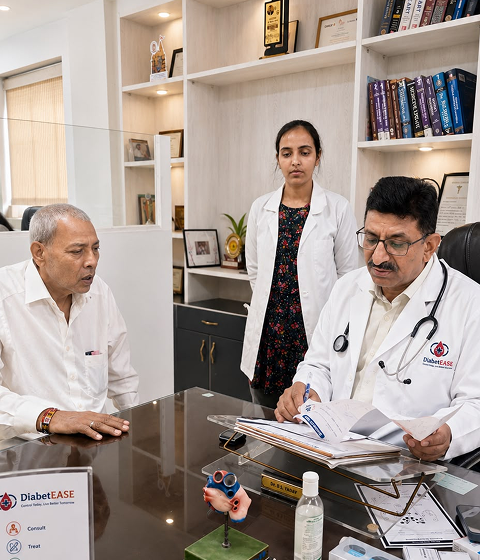
Every patient’s journey starts and stays with Dr. B.S. Yadav — a specialist with combined expertise in diabetology, cardiology, and internal medicine. One physician designs your clinical protocol, adjusts your medication, monitors your progress, evaluates your cardiac risk, and oversees every dimension of your care. One doctor owns the outcome.
Our dietician builds your Type 2 diabetes diet plan around your actual kitchen. Rice, roti, dal, sabzi, paratha, idli — nothing is banned. Portions are calibrated. Meal timing is structured around your workday and your family’s routine. Reversal fails if the patient eats separately from the household.
You already know what you should eat. The reason it hasn’t worked isn’t knowledge — it’s behaviour. Emotional eating after a stressful day. Giving up after two weeks because the numbers didn’t move. Our wellness counsellor addresses these barriers directly with practical, consistent coping strategies.
Your eyes, kidneys, nerves, feet, and heart are all at risk — and most clinics don’t screen until something goes wrong. At DiabetEASE, every major complication is screened as part of your standard protocol. And because Dr. Yadav is also a cardiologist, your cardiac risk doesn’t get referred out.
When one person in the household has diabetes, the kitchen, the grocery list, and the family’s eating patterns all need to shift. Your spouse learns to cook the same food differently, and children are screened for pre-diabetes risk. Your household becomes part of the solution.
Through our Swasth Sunday camps, we reach people before diabetes reaches them. Free monthly diabetes screening, community awareness drives, and neighbourhood health programmes — because prevention at scale is the most impactful form of diabetes care.
While clinical outcomes vary by individual physiology, patients with the highest statistical likelihood of reversal meet these criteria:
Diagnosed with Type 2 diabetes within the first 5 to 7 years. Pancreatic beta-cells retain high functional recovery capacity during this window.
Individuals who are overweight and can safely respond to a highly structured, medically monitored weight management protocol.
A starting HbA1c ideally below 9% to 10% which allows for safer, faster metabolic stabilization without permanent dependence on complex drug combinations.
A strong personal commitment to long-term dietary modification, sleep hygiene, and physical activity habits mapped directly around your lifestyle.
Even if you don't fit this profile perfectly, significant improvement is almost always possible — fewer medications, lower doses, better blood sugar control, reduced complication risk, and a quality of life that looks nothing like what you have right now.